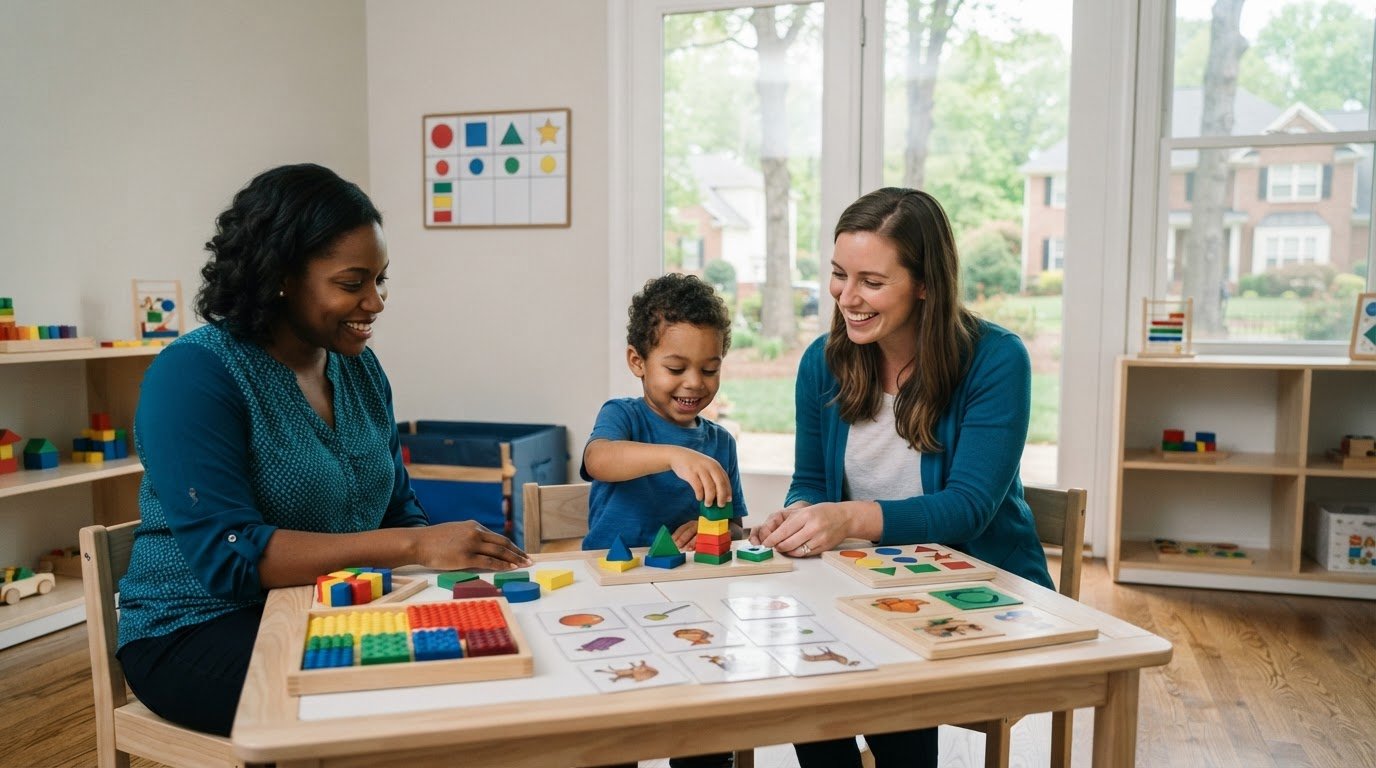

What if the first step isn’t asking your child to stop a behavior, but helping them express the need behind it? When a child can’t easily ask for a break, help, attention, or a favorite activity, frustration may show up in other ways. Functional communication training ABA teams use focuses on teaching an accessible way to communicate that serves the same purpose, while taking the child’s distress and preferences seriously.
It’s understandable to wonder what this looks like in practice, or whether your child needs to speak to take part. They don’t. Communication might include words, signs, pictures, gestures, or a communication device, chosen to fit the child. The goal isn’t to insist on one “right” way to communicate. It’s to build a practical response the child can use and the people around them can recognize.
This guide explains how FCT goals are selected, what an ABA team observes, and how families can support communication during everyday routines. You’ll also learn how clinic-based therapy, parent coaching, and practice at home or in the community can work together. Progress starts with listening, collaboration, and meaningful opportunities for your child to be understood.
What Is Functional Communication Training in ABA?
Functional communication training (FCT) teaches a child a useful way to express a need that may be connected to a behavior. Functional communication training is an individualized ABA approach that teaches an effective communication response to meet a meaningful need. The team works to understand what the child may be communicating and identifies a response that is accessible and practical for that child.
FCT isn’t simply a plan for getting a child to stop doing something. It aims to build a communication skill, such as asking for help or a break, that can serve the child’s need. A child’s distress is information, not something to dismiss. The goal is to support communication while respecting the child’s preferences and considering what is happening around them.
Functional communication training ABA teams develop is not a single script, device, or set of words for every child. Goals reflect what the child wants to communicate, how they communicate now, and which responses they can use in everyday situations. The team and family can keep those goals useful beyond a therapy activity by identifying where and with whom the skill needs to work.
What does “functional” communication mean?
A response is functional when it effectively communicates a meaningful need. If a task feels difficult, for example, a child might learn to request help rather than leave the activity. The request gives the child a clear way to signal what they need, while helping adults understand how to respond.
The same behavior can have different purposes for different children, or in different situations. Leaving an activity might relate to difficulty, a need for a break, or something else. The team shouldn’t assume the reason based on what the behavior looks like. Looking at what happened before and after, along with the child’s individual needs, helps shape a communication goal that fits.
Who can use FCT, and what can communication look like?
FCT can be tailored to different communication abilities. A child might communicate with spoken words, signs, pictures, gestures, or augmentative and alternative communication (AAC), including a communication device. Spoken language isn’t a prerequisite for communication goals. The focus is on choosing a response the child can access and use, not requiring one particular form of communication.
The response should also make sense in the child’s daily life. A picture, sign, or gesture may be easier to use in a particular moment than a spoken phrase; another child may prefer words or a device. The team can consider the child’s abilities and preferences, then work with caregivers to set goals for routines at home, in the clinic, or in the community.
Families can help by sharing what their child enjoys, avoids, and seems to be asking for in everyday situations. Those observations add context the team may not see during a session. FCT is most relevant when the child has a practical way to express a need and the people around them recognize and respond to that communication.
How ABA Identifies the Need Behind a Behavior
Before choosing a communication goal, the ABA team needs to understand the situation around the behavior. A BCBA may gather relevant history, observe the child in different routines, and ask caregivers what tends to happen before and after. These details help the team form a working hypothesis about what the child may be communicating, rather than treating one incident as a complete explanation.
Behavior can relate to gaining attention, getting access to an item or activity, seeking help, or taking a break from a difficult or overwhelming situation. The same behavior may serve different purposes in different contexts. A child who leaves a table during one activity might need help with the task, while leaving another setting could signal a need for a pause. Context matters.
How observation informs an FCT plan
One way to organize observations is to note the antecedent (what happened before), the behavior (what the child did), and the consequence (what happened afterward). This pattern can reveal useful clues without assuming that what happened afterward caused the behavior or that the same explanation applies every time.
For example, if a child often pushes materials away after a lengthy task begins, the BCBA may look at whether the task is difficult, whether support is available, and what follows when the child pushes the materials. Caregiver observations from home, school, or community routines can add context that may not appear in a clinic observation. Comparing repeated situations can help the team develop and refine a working hypothesis. A family-friendly functional behavior assessment guide explains more about this assessment process.
The assessment, the behavior’s context, and the child’s communication abilities all inform an FCT plan. The plan is a reasoned starting point, not a label for the child. If later observations don’t fit the hypothesis, or the response isn’t useful in practice, the team can revisit its understanding with the family.
Why communication must match the behavior’s function
A replacement response is more likely to be useful when it serves a similar purpose to the behavior. If a child pushes a task away when they need assistance, a plan might teach them to request help. The request could be spoken, signed, shown on a picture, or communicated with a gesture, depending on what the child can readily use.
One response may not address every situation. A child might need one way to ask for help and another to request a break or access to an activity. The team can consider whether each response is clear, practical, and available where the need arises. Family input helps connect goals to real routines and the child’s preferences. The plan should support communication, not expect the child to tolerate every situation without expressing a need.
Does FCT Mean Suppressing Behavior or Requiring Speech?
No. FCT is intended to build a useful communication response, not erase a child’s needs or require them to hide distress. In functional communication training ABA, the team considers what a child may be expressing and teaches a practical way to communicate that need. The child’s behavior remains important information. If distress continues, it deserves attention rather than automatic correction.
This distinction can guide family conversations about goals. A plan should help adults understand and respond to the child, not focus only on making behavior less visible. If a child signals that an activity is difficult, the team can consider whether support, a pause, or another adjustment is appropriate. Learning a different way to ask should not mean the child has to keep going regardless of their needs.
FCT is not limited to spoken words
Communication can take a form that fits the child’s strengths and access needs. A child may use speech, signs, pictures, gestures, or augmentative and alternative communication (AAC), such as a communication device. The purpose is to make a message understood, not to choose the response that looks most familiar to other people.
For example, a child who needs help opening a container might say “help,” hand over a picture, use a sign, or activate a message on a device. Each can communicate the same need. The right option is one the child can use meaningfully in that situation. Spoken language isn’t a requirement for communication goals, and using AAC or another communication form doesn’t make a child’s message less valid.
FCT is not a promise that behavior disappears
Learning a new response takes time and practice, and it won’t make every difficult moment disappear immediately. A child may not yet know how to use the response, may be too distressed to access it, or may find that other people don’t understand it. These moments are reasons to look closely at the situation, not to assume the child is unwilling to communicate.
The team can review whether the response is accessible, practical, and understood by the people around the child. If a child uses a break card but adults continue the activity without acknowledging the request, the communication isn’t serving its purpose. Caregivers can share what they see across routines, and the team can observe whether the plan needs adjustment.
Respectful goals prioritize safety, dignity, and meaningful communication. They take the child’s preferences seriously and allow room to reconsider an approach when it isn’t working as intended. Progress may look different from one child to another, so ongoing observation and family collaboration matter. The aim is not compliance for its own sake; it’s helping the child express needs in a way others can recognize and respond to.
How Families Can Support FCT in Everyday Routines
Families don’t need to turn the day into a series of therapy exercises. A few manageable steps can make communication easier to use in ordinary routines. Work with the clinical team to agree on a response, keep it accessible, practice when the child is calm, and share what you notice. This keeps functional communication training ABA connected to the child’s life and gives the team useful information for adjusting support.
- Agree on the response. Clarify what the child can do to communicate a particular need, such as asking for help or a pause.
- Make it accessible. Keep the relevant picture, device, or other communication support within reach where the need is likely to come up.
- Practice calmly. Use a natural opportunity in a familiar routine, without creating pressure to respond perfectly.
- Share observations. Tell the team what seemed easy, difficult, or helpful, including how other people responded.
Practice communication without creating pressure
Calm moments can offer a low-pressure chance to get familiar with a communication response. If a child uses a picture to request a preferred activity, for example, a caregiver might make the picture available when that activity is relevant. When the child uses the agreed response, acknowledge it promptly and respond in a way that fits the request and the situation.
Practice should feel supportive, not like a test. Repeating prompts when a child is overwhelmed can add pressure instead of helping them communicate. Follow the plan developed with the clinical team, notice the child’s cues, and allow time to respond. Everyday opportunities are useful, but not every interaction needs to become a teaching moment.
Coordinate support between sessions and settings
Share specific observations with the ABA team: which routines make communication easier, when the child seems unsure how to respond, and whether familiar people understand the message. These details can help caregivers and clinicians coordinate wording, visuals, and expectations. Parent coaching for autism supports caregivers as they practice strategies and discuss what’s working in daily routines.
Generalization means adapting support so a communication skill can be useful with different people and in different settings. It doesn’t mean expecting identical performance everywhere. A child might use a picture at home and a gesture with a familiar adult in the community. The team can plan for those differences while keeping the purpose of the communication clear.
Family insight helps keep FCT practical and individualized. Learn more about family-centered ABA support and how caregiver collaboration can connect communication goals with everyday routines.
Building Individualized ABA Support for Families in Cary, Apex, and Raleigh
Communication goals are most useful when they reflect the child, not a preset checklist. In functional communication training ABA, planning can account for a child’s current strengths, preferred ways to communicate, daily challenges, and family priorities. One family may want support with requesting help during routines; another may focus on communicating a need for a break. The aim is to choose goals that matter in the child’s real life.
That planning works best as a partnership. A BCBA brings clinical assessment and evidence-based ABA practices, while caregivers share what they notice across familiar routines. When appropriate, the child’s broader support team can add context about communication in other settings. Together, the people supporting the child can align on meaningful goals and review whether strategies remain practical as the child’s needs and routines change.
What individualized FCT support should center on
Individualized support starts with the child’s communication needs and the family’s priorities. As a BCBA-owned practice, Divergent Minds ABA coordinates ABA planning around those priorities, with goals informed by observation and ongoing collaboration. In clinic-based ABA therapy, structured clinical support gives the team opportunities to work on a communication skill and observe how the child responds. The focus stays on building a useful skill, not expecting every child to communicate in the same way.
Families can help shape the plan by describing what a meaningful difference would look like in daily life. That might mean a child can make a request understood during a familiar activity, or that caregivers know how to recognize and respond to the child’s communication. Clear priorities give the team a shared direction and make it easier to discuss what’s working and what may need adjustment.
Connecting clinic learning with daily life
A communication response needs opportunities beyond a single therapy activity to become useful across routines and relationships. At home, practice may involve familiar moments such as getting ready, playing, or asking for assistance with a routine task. Home-based ABA therapy connects support with these everyday contexts, helping the team and family consider how a skill can be used where it matters.
Generalization isn’t about expecting identical performance everywhere. A child may communicate differently with different people or in a busy community setting than at home. The team can work with caregivers to adapt supports while keeping the child’s message and goal in view. Divergent Minds ABA provides individualized ABA in clinic, home, and community settings for families in Cary, Apex, and Raleigh.
Families can also use Divergent Minds ABA’s contact page to learn about support for their child.
Start with One Meaningful Communication Goal
Your next step doesn’t need to be a complete plan. Think of one everyday moment when your child’s needs are hard to understand. What might they be trying to communicate? Which response would be accessible in that moment, and who needs to recognize it? Those observations can start a useful conversation about goals, preferences, and support that fits your family.
With functional communication training ABA, progress is shaped through careful observation and collaboration, not a one-size-fits-all script. Divergent Minds ABA is a BCBA-owned and operated practice providing individualized, evidence-based ABA for children with autism in Cary, Apex, and Raleigh. Services include clinic, home, and community settings, with family priorities helping guide meaningful goals and the team adjusting its approach based on what works for the child.
If you’re ready to explore an individualized approach for your child, contact Divergent Minds ABA to discuss ABA support. A conversation can help you identify a practical place to begin and connect communication goals with your family’s routines.
Frequently Asked Questions
Is Functional Communication Training only for young children?
No. FCT isn’t defined by a particular age; goals can be adapted to a person’s communication abilities and daily needs. For a school-age child, a useful goal might involve communicating a need during class transitions or group work. The focus is whether the skill is meaningful and accessible, not whether it’s typically taught at a certain age. Appropriate goals and support depend on the individual.
How long does Functional Communication Training take to work?
There’s no fixed timeline. Progress can depend on the communication response, how often the child has a chance to use it, and whether people understand and respond to it consistently. Rather than looking only for a quick change in behavior, the team can track practical signs, such as whether the child can use the response in a familiar routine and whether it helps others understand their message. Plans may need adjustment as observations accumulate.
Does a child need an autism diagnosis for FCT?
FCT is an approach for teaching communication, not a diagnostic procedure, and the approach itself isn’t defined by an autism diagnosis. Whether it’s appropriate depends on the person’s communication needs and clinical circumstances. Divergent Minds ABA provides individualized ABA services for children with autism, with goals developed around each child. This distinction can help families separate a question about a useful communication goal from questions about diagnosis or service eligibility.
Is Functional Communication Training the same as speech therapy?
No. FCT is an ABA approach that connects a communication response to a need identified through behavior assessment. Speech-language therapy focuses on communication-related areas such as understanding and using language or speech sounds, depending on the person’s needs. The approaches have different scopes, though communication goals may overlap. For example, an ABA plan might focus on making a request understood in a specific routine, while speech-language goals may address broader communication skills.
Can FCT address more than one reason for a behavior?
Yes. A behavior may relate to different needs in different situations, so an FCT plan can account for more than one function. For instance, a child might need help during a challenging activity at one time and a pause during another. The team can consider separate communication responses for those situations, then review whether each one fits the context. One message shouldn’t be assumed to cover every need.
What should caregivers share with the ABA team during FCT?
Share specific examples, including what was happening just before a moment, what your child did, and how others responded. Note details that may affect communication, such as a noisy room, a change in routine, or whether a picture or device was nearby. Also mention what your child seems to prefer and which responses are easiest to recognize. These observations help the team see how communication varies across everyday settings.