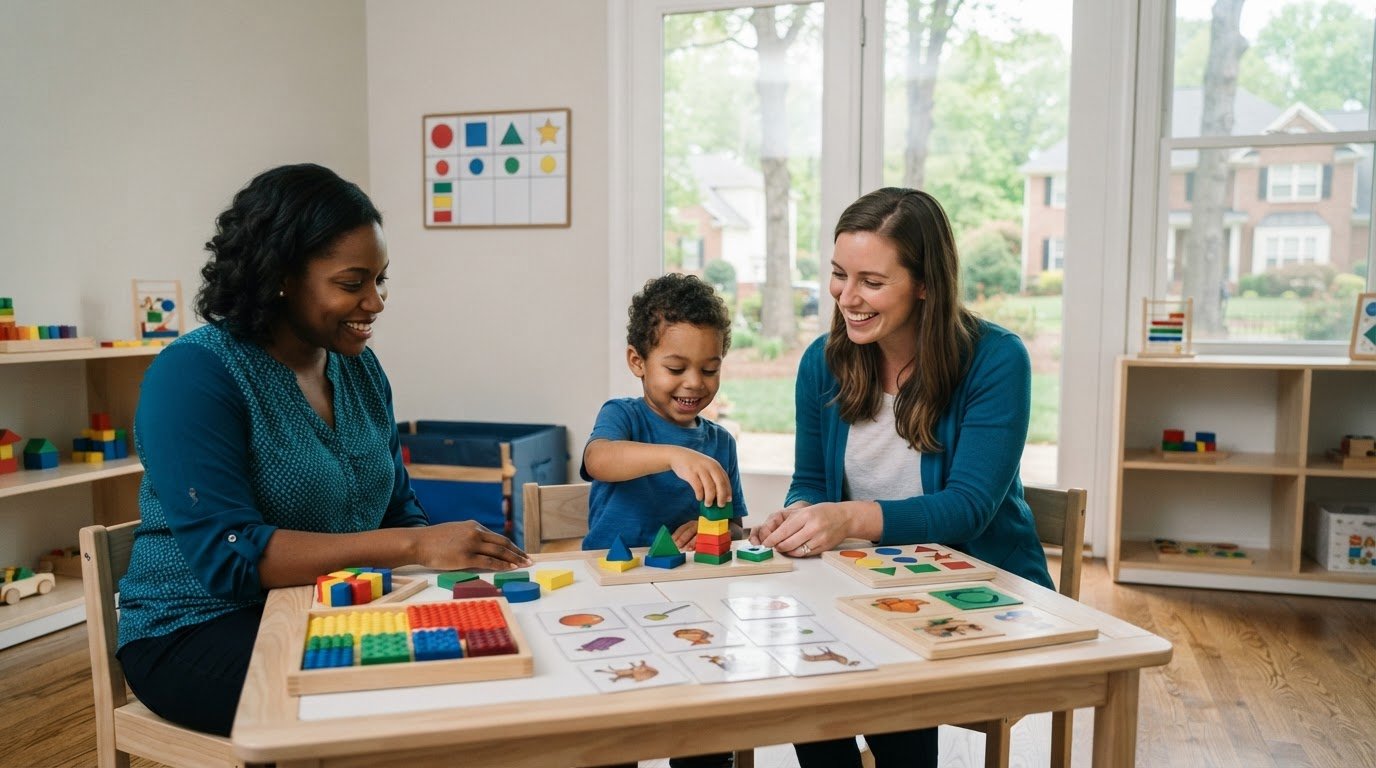

A milestone can be a starting point for understanding your child, not a score they have to pass. A later or missed skill can raise questions, but it doesn’t diagnose autism or define a child’s potential. Developmental milestones autism therapy can draw on are observations that help families and professionals notice strengths, interests, and areas where support may be useful.
It’s understandable to feel unsure when age-based lists don’t seem to match your child’s development. Those lists offer general guidance, while each child communicates, learns, and builds everyday skills in their own way. Therapy is most useful when observations lead to individualized goals that matter in daily life, rather than treating a checklist as a measure of worth.
This guide explains how to use milestones as conversation starters, connect observations to functional therapy goals, and share helpful details with your pediatrician and therapy team. At Divergent Minds ABA, collaborative planning brings together a child’s strengths and family priorities through individualized support in clinic, at home, and in the community. The practice serves families in Cary, Apex, and Raleigh.
Developmental Milestones in Autism Therapy
Milestones are observable skills that offer a broad picture of how a child is learning and developing. They can help families notice emerging abilities, changes over time, and areas where a child may benefit from support. They aren’t pass-or-fail standards. The CDC’s milestone checklists describe skills that most children, about 75%, are expected to show by a given age. A difference from that reference point can be a reason to discuss development, not a conclusion about a child.
Development includes interconnected areas. Communication can involve gestures, sounds, words, or other ways of expressing needs. Social-emotional development may include sharing enjoyment or responding to another person. Cognitive skills include exploring how objects work or solving simple problems; movement includes reaching, walking, or handling toys. These examples provide context, not a complete picture of any child.
In developmental milestones autism therapy, observations can help guide questions and individualized goals, but milestones alone can’t diagnose autism or predict a child’s future. Developmental monitoring describes what a child is learning over time; diagnosis requires a broader evaluation of development and behavior.
What developmental milestones can show
A milestone is one example of a skill that may emerge during development. Children can reach similar skills at different times and express them in different ways. For instance, one child may ask for a toy with spoken words, while another may point, gesture, use pictures, or communicate with a device. The useful question isn’t only whether a skill is present, but how the child uses it and what helps them participate.
Families and therapists can notice patterns across routines: how a child asks for help, joins a preferred activity, explores a new toy, or moves through a familiar space. These observations can reveal strengths and practical support needs without reducing development to a checklist. A broader overview of Autism Spectrum Disorder can provide background on developmental, social, and communication characteristics, but it doesn’t replace individualized assessment.
Why a milestone list is not a diagnosis
A milestone list is a tool for tracking and discussing development, not a diagnostic test. Autism is identified through a formal evaluation that considers a child’s developmental history and a wider pattern of characteristics, rather than one behavior or a single missed milestone. A child’s preference for playing alone, for example, doesn’t establish a diagnosis by itself. Avoid drawing conclusions from isolated observations; instead, note what happened and the context around it.
If you have concerns, share specific examples with your pediatrician, including skills you’ve noticed, situations where communication or participation feels difficult, and any changes over time. These details can help guide a discussion about next steps. In therapy, observations can also inform goals tied to meaningful daily routines. Divergent Minds ABA provides individualized clinic-based ABA therapy shaped by a child’s strengths and family priorities, alongside support in home and community settings.
How autism therapy turns developmental observations into individualized goals
Observations become useful when they help answer a practical question: what would make everyday life more comfortable, connected, or independent for this child? In developmental milestones autism therapy, a BCBA can work with a family to understand what a child already does, what circumstances support a skill, and where the child may want or need more support. This is therapy planning, not autism diagnosis.
A collaborative planning process often moves through four connected steps:
- Share observations. Describe what you see at home, school, or in the community, including what your child enjoys and how they communicate.
- Clarify priorities. Identify which situations matter most to your family and child, such as asking for help during a routine or joining an activity with others.
- Shape a goal. Define a useful skill in observable, everyday terms, while respecting your child’s communication and individual strengths.
- Review and adjust. Discuss what is changing, where the skill is useful, and whether the goal or support should be adapted.
An individualized therapy goal describes a meaningful skill a child can practice in context, with a plan shaped around that child’s strengths and support needs. It isn’t a promise about how quickly a skill will develop or a requirement to match an age-based list.
From everyday observations to a useful therapy conversation
Specific examples help the team understand more than a general statement such as “communication is hard.” You might describe when your child requests a favorite snack, what they do if it’s unavailable, and what helps them communicate in that moment. Note what happened before and after, without assuming anyone caused the difficulty. Family priorities help turn that information into goals that matter in real routines.
For example, a family may want mornings to feel more manageable. The team can discuss the child’s existing ways of communicating, which parts of the routine are challenging, and what useful participation could look like for that child. Parent coaching helps families take part in collaborative planning and connect goals with everyday priorities.
How assessment information can inform goals
Before shaping goals, clinicians gather information about a child’s skills, interests, communication, environment, and support needs. A behavior’s context can also matter: a functional behavior assessment explores patterns around behavior to better understand what may be influencing it. This is not the same as a diagnostic evaluation, and it doesn’t turn a milestone list into a fixed treatment plan.
The Council of Autism Service Providers offers professional resources related to autism services. In individualized ABA, the central question is how to support meaningful participation while honoring the child’s needs and family priorities. Families in Cary, Apex, and Raleigh can discuss their observations and therapy priorities with Divergent Minds ABA.
If you’re ready to discuss how family priorities can inform ABA support, connect with Divergent Minds ABA.
Milestone charts versus your child’s developmental profile: what should guide decisions?
A chart offers a reference point. Your child’s developmental profile adds the context needed to understand what skills mean in daily life. Charts can help families notice questions to discuss, but they can’t show a child’s full strengths, preferences, communication style, or the conditions that make participation easier. A difference from a chart is a reason for thoughtful conversation, not an automatic conclusion about development.
What age-based milestone charts can and cannot tell families
Charts summarize general developmental expectations. They can help a family describe a concern or decide what to bring up with a pediatrician, but they don’t account for every way a child may show a skill. For example, a child may communicate a choice with a gesture, spoken words, or another communication method. The chart alone can’t explain what that communication means for that child.
Use the reference as a prompt, not a verdict. A difference deserves attention and discussion, but it doesn’t by itself establish autism or determine what support is appropriate. Age-based examples are not a substitute for developmental screening or a diagnostic evaluation. Avoid treating any single behavior as proof of a broader conclusion.
Why progress should be understood in individual context
The same skill can look different across children, and even for one child across settings. A child might comfortably take part in a familiar activity at home but need different supports in a busy community setting. That contrast can point to the importance of predictability, sensory conditions, communication access, or familiarity. It doesn’t make one version of participation more valuable than another.
For developmental milestones autism therapy to inform useful decisions, teams need to consider more than whether a behavior can be counted. They can look at whether a skill supports the child’s interests, comfort, communication, and participation in routines that matter to the family. A goal might focus on making a choice during a preferred activity, respecting the child’s communication style rather than expecting every child to follow an identical timeline.
Families and clinicians can review goals as a child’s interests, routines, or support needs shift. Progress may include greater ease, choice, or engagement, not just a new skill on a list. Individualized ABA planning can connect observations with priorities while keeping the child’s developmental profile in view.
How to track developmental observations and share them with your child’s team
A few everyday examples can make a conversation with your child’s pediatrician or therapy team more specific. Tracking doesn’t need to become a score sheet or a home assessment. The aim is to capture what you notice, including what your child enjoys and what helps them take part, so professionals can understand the context and hear your questions.
A simple observation routine families can use
Choose a familiar situation that matters to your family, such as getting ready to leave, playing a favorite game, or asking for a snack. Observe naturally rather than testing a skill on demand. A brief note can be enough. Use this four-step guide:
- Name the situation. Note the routine, setting, and what was happening around your child.
- Describe what you saw. Record the action or communication without judging it. Include whether your child used speech, gestures, pictures, a device, or another method.
- Capture the support and response. Note what help was offered, what happened next, and whether anything seemed to make participation easier.
- Include strengths and questions. Record what went well, what your child seemed interested in, and anything you’d like to understand better.
For example: “During the evening routine, Sam brought over the picture card for a favorite show after I pointed to the choice board. Sam smiled when we started watching.” This describes the context, communication, support, and successful participation without scoring the moment or comparing Sam with another child. You don’t need to write something down every time. Keep notes brief and manageable.
Preparing for a conversation with professionals
Before an appointment or therapy discussion, choose a few examples that show what’s going well and where questions remain. Patterns can be useful: perhaps a child communicates more easily in a familiar room, or a visual cue helps during one routine. Share what you’ve noticed without trying to explain or diagnose it. Your child’s pediatrician can discuss developmental concerns and help identify appropriate next steps.
Caregiver perspectives also help connect therapy planning with family routines. Through parent coaching, families can collaborate on practical ways to support meaningful skills across everyday situations. Notes can help start that conversation, but families aren’t expected to conduct clinical assessments or decide which goals a child needs.
Developmental milestones autism therapy can draw on are more useful when observations reflect a child’s real experiences, communication, and environment. Bring your questions, not a perfect record. The team can consider the details with you and revisit priorities as your child’s needs and routines change.
To discuss how family observations can inform collaborative ABA support, contact Divergent Minds ABA.
What milestone-informed ABA support can look like in Cary, Apex, and Raleigh
Milestone observations can help families describe what their child is learning and where everyday participation could feel easier. They’re one part of the conversation, not a treatment formula. At Divergent Minds ABA, a BCBA-owned practice serving children with autism, individualized, evidence-based ABA connects family priorities with skills that are meaningful to the child. The focus is not on making every child follow the same developmental timeline.
Connecting therapy goals with skills that matter to the child
Collaborative planning considers a child’s strengths, interests, communication style, and support needs alongside family priorities. A goal might relate to making choices during an activity, participating in a familiar routine, or building independence in a way that respects how the child communicates. The team can consider what the child finds motivating and what the family sees as useful in daily life.
In a clinic setting, individualized clinic-based ABA therapy provides a setting for skill-building shaped around those priorities. The intent is to support meaningful learning, not to test whether a child meets a milestone or guarantee a particular outcome or timeline. Divergent Minds ABA also provides home-based and community-based support, where therapy goals can connect with everyday routines and places.
For example, a family might share that their child enjoys a particular activity but finds transitions away from it challenging. That observation can help the team discuss a useful, respectful support goal, taking into account the child’s communication and what makes the transition easier. The goal should connect to participation and family priorities, rather than simply checking off a skill.
A supportive next step for local families
Questions are a reasonable place to begin. You don’t need a complete record of every skill or a perfect explanation of what you’ve noticed. A few examples of your child’s interests, strengths, and support needs can help start a collaborative discussion about what matters most to your family.
Families in Cary, Apex, and Raleigh can talk with Divergent Minds ABA about individualized ABA support and therapy planning that reflects their child’s needs. Developmental milestones autism therapy may help inform a conversation, but a child’s value and potential aren’t measured by a chart. Planning can stay centered on the skills, routines, and forms of participation that are meaningful to that child and family.
If you’re ready to explore a supportive next step, talk with our team about your child’s support needs.
Take the next step at your family’s pace
Your observations and questions are a meaningful place to begin. You don’t need to have every concern organized or know which goal should come first. A conversation can help you consider what matters most to your child and family, and what kind of support may fit those priorities. Developmental milestones autism therapy can inform that discussion, while your child’s individual strengths and needs remain central.
Divergent Minds ABA is a BCBA-owned practice offering individualized, evidence-based ABA in clinic, home, and community settings. Parent coaching and social skills groups are also available as part of family support. The goal is a thoughtful partnership focused on meaningful skills, with room to adapt as your child’s needs and family priorities evolve.
If you’re ready to talk through your child’s support needs, connect with our team. Your questions are welcome, and each conversation can help clarify a supportive next step. Progress can take many forms, and your child deserves support that recognizes the person behind every milestone.
Frequently Asked Questions
Are developmental milestones the same for every autistic child?
No. Milestones are general reference points, not a timetable that every autistic child follows. A child might show a skill in one setting but not another, or use a different communication method to express the same need. For example, visual cues may help a child follow a routine. Consider what supports participation and what the child enjoys, rather than comparing their development with another child’s path.
Can a child lose a skill they previously had?
Yes, and a noticeable loss of a previously used skill is a reason to contact the child’s pediatrician promptly. Write down what changed, when you first noticed it, and whether anything else in the child’s routine or health changed around the same time. These details can help guide the conversation, but families don’t need to determine the cause. A regression alone doesn’t establish a diagnosis.
How often should developmental milestones be screened?
The American Academy of Pediatrics recommends general developmental screening at 9, 18, and 30 months, and autism-specific screening at 18 and 24 months. These screenings are part of broader developmental care, not a diagnosis or therapy plan. Families can bring up concerns at any visit rather than waiting for a scheduled screening. The child’s pediatrician can help interpret results and discuss whether follow-up is appropriate.
Is ABA therapy only appropriate after an autism diagnosis?
An ABA provider does not diagnose autism through therapy, and milestone observations alone don’t determine whether ABA is appropriate. Service eligibility and insurance coverage can depend on a child’s circumstances, clinical requirements, and payer rules. If you’re considering support, discuss developmental concerns with your pediatrician and talk with the ABA team about the child’s needs and relevant service or coverage requirements.
Can ABA therapy support a child who communicates without spoken words?
Yes. In developmental milestones autism therapy planning, communication goals can reflect how a child currently expresses choices, requests, discomfort, or interest. Spoken words aren’t the only way to communicate. Families can share which methods their child uses and what helps them be understood in different situations. The clinical team can use that information to consider meaningful goals and coordinate with the family and other professionals involved.
Should families wait until a child misses several milestones before asking for help?
No. You can raise a concern even if you’ve noticed just one change or difficulty. For instance, tell the pediatrician if a child’s participation in a familiar routine has shifted or if communication feels harder in a particular situation. Share what you’ve observed without assuming what it means. A conversation can help determine whether screening or follow-up makes sense, without defining the child’s future.
Does ABA therapy replace speech therapy or occupational therapy?
No. ABA, speech-language therapy, and occupational therapy use different approaches and may address different needs, so one doesn’t automatically replace another. If a child receives more than one service, families can share relevant goals and observations across the care team, with appropriate coordination. For example, discussing how a child communicates during daily routines can help professionals understand where their work may connect while keeping each service’s role clear.