More than 27% of children with autism exhibit self-injurious behaviors. Effective ABA support focuses on understanding what may be driving the behavior, teaching safer ways to communicate, and setting individualized goals; ABA therapy for self-injurious behavior in Apex can also be coordinated with medical assessment when health factors may contribute.
When a child is hurting themselves, it’s natural to want the behavior to stop quickly. A supportive plan also considers what the child may be communicating and how to help them express their needs more safely.
This article explains how Functional Behavior Assessment and Functional Communication Training can guide support, why medical factors deserve attention, and how individualized goals help families and clinicians track meaningful progress. It also covers reinforcement, safety planning, and consistent support across settings.
What role does Functional Communication Training (FCT) play within ABA therapy in addressing self-injurious behaviors?
Functional Communication Training teaches a safer way to express needs that self-injury may communicate. A Functional Behavior Assessment helps identify what happens before and after the behavior, so teaching can address its possible function.
Functional Assessment of Triggers
A Functional Behavior Assessment (FBA) examines the setting, triggers, and consequences associated with self-injury. For example, a clinician may record whether head banging occurs during a noisy transition, after a difficult request, or when access to an activity ends. These observations help identify possible functions, such as asking for help, escaping a demand, or meeting a sensory need. The distinction matters because one response may not fit every situation.
Communication as a Replacement Behavior
Functional Communication Training (FCT) teaches a practical request that can serve the same function as self-injury. A child might learn to say “break,” hand over a “help” card, or use a communication device to request more time. The clinician selects and practices a response the child can use in relevant situations. Caregivers can then recognize and respond to that communication consistently.
When sensory regulation appears relevant, the plan may teach safer alternatives, such as squeezing an appropriate item or pushing a pillow. The alternative should fit the assessment, not be chosen simply because it seems calming. For a child who self-injures when a task feels difficult, teaching “help” or “break” may be more functional than offering a sensory item. Tracking what happens before and after each response helps the team refine its approach.
For North Carolina Medicaid, eligibility and ABA coverage depend on program rules and applicable benefit criteria. Self-injury can be described as part of a child’s treatment needs, but the behavior alone does not establish eligibility or coverage.
ABA has also drawn criticism. Therapist Neurodiversity Collective opposes using ABA, restraint, or seclusion to manage distress such as self-injury. Families can consider whether a plan prioritizes communication, safety, and the child’s dignity.
For private insurance in North Carolina, coverage depends on the policy’s benefits and review of clinical need. Describing the behavior, its impact, and treatment goals can help clarify how a plan applies its coverage criteria.
Near Apex, look for ABA support that connects assessment findings to individualized communication goals. Consider how caregivers will be involved and how progress will be tracked in situations such as transitions or denied access.
During intake, the team typically gathers caregiver observations about when and where self-injury occurs, including during transitions, around noise, and alongside changes in sleep or injury risk. Treatment can combine assessment, communication teaching, and progress monitoring, with goals adjusted as the child’s needs become clearer.
What Are Effective Methods for Managing Self-Injurious Behavior in Autism Through Applied Behavior Analysis (ABA) Therapy and Other Therapies?
Positive reinforcement can strengthen useful, safer skills when it follows a response the child is learning. Effective methods connect reinforcement to individualized goals and the possible function of the behavior.
Positive Reinforcement and Skill Teaching
Positive reinforcement means providing something meaningful after a desired response, making that response more likely in similar situations. During teaching, a clinician might praise a child for asking for help instead of biting, or offer access to a preferred activity after a safe request. The response should be immediate and meaningful to that child.
Breaking a complex skill into smaller steps can make progress easier to recognize. A child might first touch a communication card, then hand it to a caregiver, and eventually use it during a difficult transition. Parents and other caregivers can support practice by responding consistently to the skill being taught. Reinforcement supports learning; it should not depend on suppressing the child’s communication or distress.
Differential Reinforcement and Extinction
Differential reinforcement provides reinforcement for a selected safer response while withholding a consequence that may maintain self-injury. For example, a plan may reinforce asking for a break rather than allowing self-injury to reliably end a task. The replacement response needs to meet the same need, not merely look more acceptable.
Extinction refers to no longer providing the consequence that has been maintaining a behavior. It is not a direction to ignore injury, pain, or a request for help. Because self-injury carries safety concerns, any procedure should be individualized, guided by assessment, and paired with protective responses and skill teaching. Caregivers should understand exactly how to respond in each situation.
Evidence and Outcomes for ABA
Research on ABA interventions to reduce self-injurious behavior spans more than five decades. That history supports careful consideration of behavior-based approaches, but the relevant outcome is whether an individual plan improves safety and builds useful skills.
To evaluate ABA therapy, outcomes can include changes in self-injury and the child’s use of alternative responses. A team can track the frequency, duration, and context of behavior alongside skills such as requesting help or managing a transition. This makes progress more informative than counting behavior alone. The findings can guide adjustments to teaching and reinforcement.
For families considering ABA therapy for self-injurious behavior in Apex, treatment planning should connect assessment, reinforcement, and measurable goals. The approach also needs to respect the child’s communication and prioritize safety. Consistent caregiver responses can help a newly learned skill become useful beyond therapy, including during home routines.
Medical factors that may contribute to self-injury
Self-injury can have medical and behavioral contributors, so an applied behavior plan should not treat every episode as purely behavioral. Pain, sleep disruption, medication changes, and gastrointestinal discomfort can contribute to sudden or changing behavior in children with autism spectrum disorder.
A sudden increase deserves attention to what changed, not only what happened immediately before the behavior. For example, a child who begins hitting their head during familiar routines may be experiencing pain or disrupted sleep. Caregivers can share observations about timing, eating, sleep, illness, and medication changes with the child’s medical providers. This information can help distinguish a health concern from a pattern tied to a particular activity or environment.
Pain can be difficult for a child to express through speech. A child might communicate discomfort through self-injury, withdrawal, or changes in daily routines. Functional communication teaching can give the child another way to express “help,” “hurt,” or “stop,” using speech, a visual card, or a communication device. This support complements medical attention; it does not replace assessment of possible illness or pain.
Medical evaluation matters when self-injury appears suddenly, changes in intensity, or occurs alongside signs of illness or disrupted sleep. Caregivers can describe when the behavior began, where it occurs, and any recent medication changes or digestive discomfort. When an injury requires urgent attention, the safety plan should include seeking medical or emergency support. These details give medical providers useful context for evaluating the child.
ABA and dialectical behavior therapy (DBT) are different approaches, and neither should be treated as a substitute for medical assessment. ABA uses behavioral assessment and teaching to build functional communication and safer alternatives. DBT focuses on skills for managing emotions and distress. The relevant support depends on the child’s communication, needs, and treatment goals, while physical symptoms require medical evaluation.
Medication decisions belong within medical care. When severe behavior occurs alongside a health concern or significant distress, medical providers can assess the factors involved and consider appropriate care. Caregivers can share observations about timing, changes, and effects on daily routines. An ABA plan can coordinate teaching goals with relevant medical guidance without treating medication as a replacement for communication or safety supports.
Alternatives to ABA for self-injurious behavior include medical assessment and individualized supports focused on communication, emotional regulation, or sensory needs. Families can discuss approaches such as DBT with relevant professionals and consider how each addresses the child’s specific needs.
For children in Apex, coordinated care connects observations about health with an understanding of behavior. Community-Based ABA Therapy can support practice in everyday settings, while medical providers address pain, sleep, gastrointestinal discomfort, or medication concerns. This distinction helps families pursue safety and meaningful ways for the child to express needs.
Individualized treatment plans and SMART goals
An individualized plan connects assessment findings with goals that matter in a child’s daily life. For children with autism, self-injury may affect communication, participation, or safety in different ways, so interventions should reflect the child’s abilities, needs, and routines rather than follow a generic template.
The SMART framework helps make each goal clear: Specific, Measurable, Achievable, Relevant, and Time-bound. For example, instead of “communicate more,” a plan might target using a spoken word, picture, or device to request help during a challenging activity. The team can define what counts as the response, how progress will be recorded, and when the goal will be reviewed.
- Specific: Identify one observable skill, such as requesting a break.
- Measurable: Record how often the child uses that response in the agreed situation.
- Achievable: Match the first step to the child’s current communication ability.
- Relevant: Choose a skill that addresses a meaningful barrier to participation or safety.
- Time-bound: Set a review point for examining progress and deciding whether to adjust the goal.
Measurement should capture more than whether self-injury occurred. A treatment team can track its frequency, duration, triggers, and consequences alongside the child’s use of replacement skills. For instance, records might distinguish behavior during transitions from behavior during independent play. Comparing those patterns helps the team see whether an intervention supports the intended skill in relevant situations.
Individual needs can vary across settings. A child might request a break with a picture card in a quiet clinic but need practice using that card during a busy home routine. Planning can account for communication style, sensory preferences, daily activities, and caregiver observations. A goal is most meaningful when it fits the child’s real environment, not only a structured teaching activity.
Success also means reviewing the plan when data show limited progress or a new need. The team can examine whether the goal is understandable, whether the child has enough opportunities to practice, and whether the response is useful to the child. Adjustments might include simplifying a communication response or practicing it in another routine. Review keeps interventions responsive instead of treating the first plan as permanent.
A composite case described in research materials follows Jordan, whose self-injury frequency and intensity decreased over several months. The example illustrates why tracking both dimensions can clarify change over time. For each child, SMART goals make progress visible and give families and clinicians a shared way to discuss what to continue, adapt, or teach next.
Using the SMART framework, Specific, Measurable, Achievable, Relevant, and Time-bound, keeps treatment goals structured while allowing each objective to reflect the child’s individualized plan.
ABA therapy for self-injurious behavior
ABA addresses self-injury by analyzing what happens before, during, and after behavior, then matching support to the pattern. The goal is not simply to suppress an action. A sound plan protects the child, teaches useful alternatives, and reviews whether those alternatives work in daily situations.
Behavioral analysis can examine frequency, duration, triggers, antecedents, and consequences. These measures answer different questions: how often behavior occurs, how long it lasts, and what events surround it. For example, if records show self-injury during transitions, the team can examine whether warnings, communication supports, or changes to the transition help. Identifying a pattern guides intervention more directly than relying on a general impression.
Caregivers can record practical observations that support this analysis, including:
- When and where self-injury occurs, such as during a specific routine.
- What happened before it, including a transition, noise, or request.
- Whether sleep, illness, or a recent change may be relevant.
- Whether the situation involved an immediate risk of injury.
The team uses these observations to evaluate possible functions of behavior and plan safer responses. If a child’s actions appear to communicate that a task should stop, teaching a request for a break may address that need. If noise regularly precedes self-injury, the team can examine that context and plan appropriate support. Each intervention should connect to an observed pattern rather than assume one cause for every episode.
A safety plan gives caregivers a shared response to self-injury. It can describe how to stay calm, reduce unnecessary language, protect the child from injury, and seek medical or emergency support when needed. Clear guidance helps adults respond consistently during stressful moments. It also distinguishes immediate safety actions from longer-term teaching and behavior analysis.
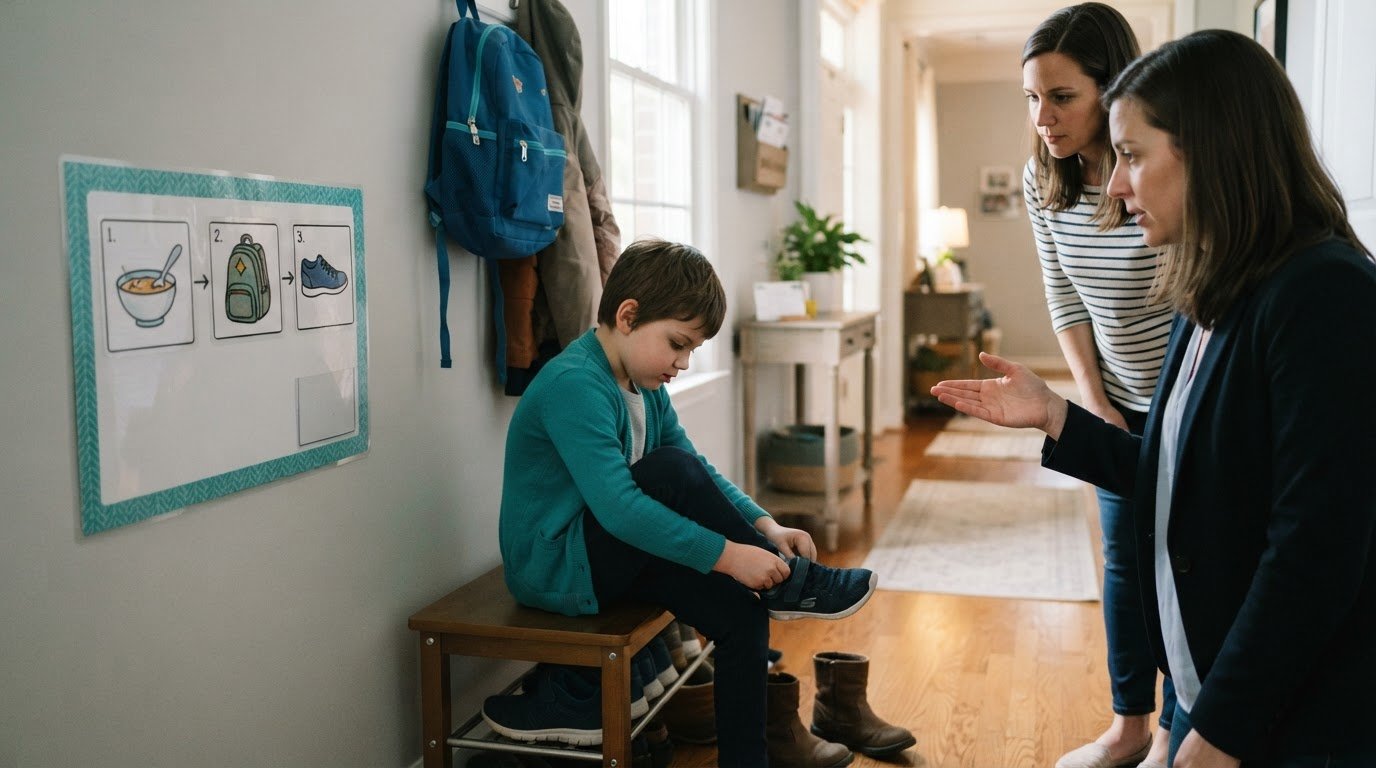
Consistency across therapy sessions, home routines, and educational settings can help a child use learned skills in different environments. For instance, caregivers and educators can use the same brief prompt for a functional request when a familiar transition becomes difficult. The team can review observations from those settings to see whether the approach supports communication and safety beyond a single session.
ABA therapy for self-injurious behavior in Apex should connect analysis to individualized action: identify patterns, protect the child, teach a relevant alternative, and review the data. A decrease in self-injury matters, as does gaining a safer way to communicate or participate. Together, these measures give families a clearer basis for understanding progress and adjusting support.
When selecting an alternative, the team must check whether it meets the child’s needs while maintaining safety. Self-injurious behavior in autistic children can include pinching, biting, head banging, scratching, and slapping. Nearly 28% of 8-year-olds with autism spectrum disorder engage in self-injurious behaviors. Caregivers and the team at Divergent Minds ABA can use this context to take observed behavior seriously, document patterns carefully, and avoid assuming that one strategy fits every child. Any response should account for immediate risk and the child’s communication, health, and daily context. Follow-up observations can help the team assess whether the plan supports safety and whether the child is using the alternative skill in everyday situations.
Divergent Minds ABA: Clinic Based ABA Therapy
Divergent Minds ABA provides personalized ABA therapy for children with autism, including support for goals related to self-injury, communication, and daily skills. Clinic Based ABA Therapy offers a structured setting for practicing individualized goals with a care team. Depending on a child’s needs and routines, Home Based ABA Therapy or Community Based ABA Therapy can support learning in everyday environments.
Families seeking collaborative, individualized ABA support can turn to Divergent Minds ABA. Treatment plans are developed around each child’s needs, with family partnership helping connect therapy goals to daily life. For children working on social interaction alongside other goals, Social Skills Groups may also be relevant.
Contact Divergent Minds ABA to discuss support tailored to your child’s needs.
Take the Next Step Toward Individualized Support
Moving forward can begin with a conversation about what your child needs in daily life and which skills could make routines safer and more manageable. For families exploring ABA therapy for self-injurious behavior in Apex, the next step is finding an approach that respects the child’s communication, abilities, and family priorities.
Divergent Minds ABA offers Clinic‑Based ABA Therapy, Home‑Based ABA Therapy, and Community‑Based ABA Therapy. These settings provide different contexts for practicing individualized goals, whether support focuses on structured learning or skills used in everyday routines. Families can discuss which setting aligns with their child’s goals and how caregivers can participate in supporting progress.
Share what you’ve noticed, what feels most urgent, and what you hope your child can learn. Contact Divergent Minds ABA to discuss your child’s support needs. Each thoughtful step can help build a clearer path forward, with your child’s safety and growth at the center.
Frequently Asked Questions
How are assessments for SIB conducted?
Assessments combine caregiver observations with a structured review of behavior and its context. A clinician may ask what the child was doing, who was present, and what changed immediately afterward. For example, noting whether an episode followed a transition or a request can help shape further assessment. The process should also consider injury risk and possible health changes, so the support plan reflects the child’s circumstances.
How can triggers and functions be identified?
Triggers and possible functions become clearer through consistent observation across relevant routines. Caregivers can note the activity, setting, sounds, transitions, and what followed the behavior. A pattern might show that episodes often happen when a preferred activity ends, while another child may react to a noisy room. These observations guide hypotheses for the clinical team to assess, rather than assuming the same explanation applies to every child.
What are the evidence-based treatment approaches for self-harm in individuals with autism?
Approaches may include functional assessment, teaching communication or other replacement skills, and reinforcing safer responses. For a child who struggles while waiting, a plan might teach a way to request more time and help caregivers respond consistently. Medical assessment also matters if behavior changes or pain may be involved. A suitable approach links the child’s needs and observed patterns to measurable goals, with safety considered throughout treatment.
What is ABA therapy, and how does it address self-injurious behaviors in children and adolescents with autism spectrum disorder?
Applied Behavior Analysis (ABA) uses observation and individualized teaching to build useful skills. For a child or adolescent with self-injury, a team may examine how behavior relates to the environment and teach another response that serves the child’s needs. Progress can include safer communication and participation, not only a change in behavior. Health concerns require medical attention alongside behavioral support.